



Welcome to Pharmocean
Welcome to Pharmocean

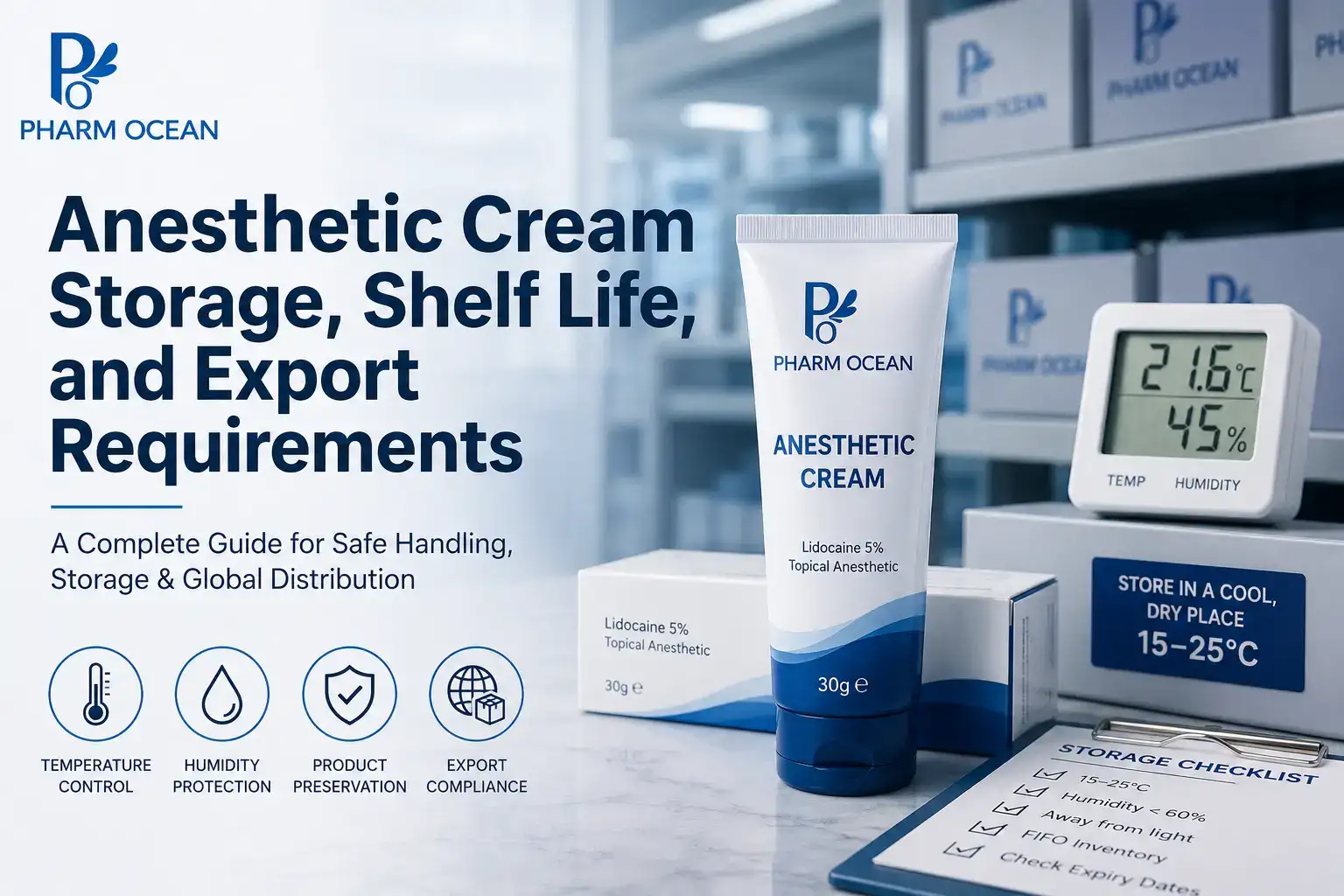
High-quality anesthetic creams are essential items for patient comfort that every aesthetic clinic stocks. But they are also among the most sensitive items in the medical inventory. A single heat wave during shipping can render an entire batch useless. A humidity spike in your warehouse can compromise seals you assumed were airtight.
This guide covers the full lifecycle of your anesthetic cream inventory. From the moment a pallet arrives at your loading dock to the final tube used in a treatment room, every step matters. You will learn how to protect your products, your reputation, and your bottom line.
Most anesthetic creams contain active pharmaceutical ingredients like lidocaine, prilocaine, or tetracaine. These molecules are surprisingly sensitive to environmental stress. They exist in a delicate emulsion, in which the ratio of oils and water is held together by emulsifiers and preservatives.
When temperatures climb above 25 degrees Celsius, that emulsion begins to break. The cream may look normal on the outside. But microscopic phase separation occurs, and the active ingredients are no longer distributed evenly. During a procedure, your patient might receive a drop of cream with half the expected numbing power. The preservatives also lose effectiveness and that increases the risk of bacterial growth.
Cold temperatures present their own dangers. Freezing causes water crystals to form within the emulsion. Those crystals puncture the microscopic oil droplets. When the cream thaws, you are left with a grainy, separated mess that cannot be remixed. This is not a product that becomes okay in consistency after shaking the bottle.
The inactive ingredients are equally vulnerable. Thickeners degrade and antioxidants deplete. Even the aluminum tubes themselves can corrode when exposed to high humidity over extended periods.
Your warehouse is the first line of defense against the slow degradation of the creams due to temperature. Wholesalers hold large volumes for extended periods. That means your storage environment must be consistently controlled.
The industry standard range is 15 to 25 degrees Celsius. It is a regulatory expectation across most global markets. You must monitor temperatures continuously, not just during business hours. Nights and weekends can bring the most dangerous swings.
Humidity control is equally vital for the chemical stability of the anesthetic creams. A humidity level below 60% is considered to be an acceptable standard. Excess moisture in the air degrades the crimped seals on tube ends, and it also compromises the cardboard packaging that protects your products during secondary shipping. Cream tubes stored in coastal and tropical regions are particularly vulnerable to humidity. An adequate protection measure for these regions is to invest in a good-quality industrial dehumidifier.
Light exposure is another environmental factor that should not be neglected. UV rays break down chemical bonds in synthetic analgesics. This is why reputable manufacturers of anesthetic creams will use opaque or heavily tinted bottles and tubes. But that is not sufficient. Additional storage measures need to be taken such as storing pallets away from windows and skylights. Use opaque shelving in your picking areas.
Inventory management should be taken seriously since that plays a great role in minimizing storage risks. Implement a strict first in, first out system(FIFO). Label every pallet with the date of receipt. Train your warehouse staff to check expiration dates before fulfilling orders. An extra thirty seconds during picking can save you thousands of dollars in returns and chargebacks.
If you are a clinic procurement manager or part of administrative staff you will notice that the clinic will remain busy continuously. Ultrasound machines will hum. Staff will move quickly between patients. In this environment, anesthetic cream storage often becomes a neglected aspect.
But you need to think carefully about where you keep your creams. Is it near the sterilization area? Heat from autoclaves can radiate into adjacent cabinets. Are you storing tubes on windowsills for easy access? Direct sunlight degrades potency within weeks.
The correct approach to safeguard your creams from damage is to assign a dedicated storage cabinet that is away from all heat sources. Install a small digital thermometer inside the cabinet. Check it daily to keep a record of the storage temperature. This simple habit builds a record of compliance.
Understanding the Handling Approach to Preserve Anesthetic Cream Effectiveness
Keep in mind that once a tube is opened, the rules change. The preservative can only protect the unopened product. Exposure to air and repeated contact with gloved hands introduces microbial contamination. To prevent this, do not squeeze the tube directly onto the patient's skin. Use a clean spatula or applicator and remember to discard any remaining cream after each procedure. Single use is the safest approach.
For multi dose vials, if you use them, the beyond use date becomes critical. Most manufacturers recommend discarding opened vials after 28 days. Write the opening date on the vial immediately. Do not trust your memory.
Expiration dates are printed on every tube. But do you truly understand what that date represents? The printed date for shelf life is according to the chemical stability tests that have been done by the cream manufacturer under perfect lab conditions. They tested the product at the recommended storage temperature. The expiration date reflects the time until potency drops below acceptable levels under those perfect conditions.
Your real world storage is not perfect. The environmental and temperature conditions will change and temperature logs may show spikes during summer months. Your warehouse space is bound to experience humidity fluctuations. These factors shorten the effective shelf life. Just because the box says the cream expires next year does not mean it remains fully potent until that date.
Visual indicators are your early warning system. Check for changes in color. A cream that was white but now appears yellowish has likely oxidized. Another sign is grainy consistency when you dispense a small amount. If it seems gritty or separates into liquid and solid phases, the emulsion has failed. Do not use it.
Disposal of expired stock also requires careful handling. You cannot simply throw anesthetic creams into general waste. These are pharmaceutical products and they should be disposed off through licensed waste management companies that specialize in medical waste. Budget for this expense. It is not optional.
Exporting anesthetic creams across borders is stressful and filled with hassles. Even seasoned wholesalers make costly mistakes in such operations. Country-specific export regulations shift constantly and one wrong piece of paperwork can leave your shipment sitting in customs for weeks.
Many wholesalers treat anesthetic creams like moisturizers, which is a dangerous assumption and a risky approach. According to regulatory authorities, topical anesthetics are classified as drugs or medicinal products. So you need to be extra careful in your documentation, your licensing, and your liability.
The United States FDA draws a hard line. Products with more than 5% lidocaine are generally prescription only. Verify your classification before shipping. Do not guess.
The European Union has its own set of exporting complexities. Your cream may fall under the Medical Device Regulation or the Medicinal Product Directive. The distinction depends on your product claims. Pharmaceutical classification demands a full dossier and marketing authorization. Budget months for this process.
Now consider the Middle East. Saudi Arabia's SFDA requires product registration. Many Gulf countries also mandate Halal certification. You must audit your supply chain for haram substances. This is not a box checking exercise. It is a genuine requirement.
Brazil's ANVISA is one of the strictest regulators globally. They require stability studies conducted in tropical conditions. They mandate Portuguese labeling with specific storage icons. Get this wrong and your shipment is refused at the port.
You are probably feeling overwhelmed. That is understandable. Here is the good news. You can systematize this complexity.
Your essential documentation checklist includes a Certificate of Analysis from the manufacturer. Include a Good Manufacturing Practice certificate. Provide Material Safety Data Sheets in the destination language. English versions are often not accepted.
Temperature controlled shipping is a must-have for international orders. Passive insulation works for short hauls. For longer transit, use active temperature monitoring devices. These record temperature throughout the journey. If an excursion occurs, you have data to defend your actions.
To keeps export risks low partner up with a customs brokers who specialize in pharmaceuticals. Generalists misclassify products and miss documentation.
Lastly, build a checklist for every export order. Review it before the shipment leaves. Double check country specific requirements. Verify your temperature monitors are calibrated.
One extra hour of preparation saves weeks of customs headaches. It saves thousands in storage fees. It protects your client relationships.
Anesthetic cream storage is not an activity that generates revenue directly. But mishandling these products can destroy your profit margins and your reputation simultaneously. You face the challenge of maintaining cold chains across continents. You manage warehouses with fluctuating climates. You juggle regulatory requirements that shift with every border crossing.
If you follow the storage framework discussed in this article and control temperature and humidity at all times. Rotate inventory religiously. Train your staff thoroughly. Document everything. Verify your export documentation before the shipment leaves your dock then you will never have to worry about your business reputation or legal trouble.
South Korea makes some of the most advanced topical anesthetic creams in the world. Buyers for tattoo parlors, dermatology clinics, and medical spas want these. However, it's not easy to import Korean anesthetic cream. They are often available as lidocaine, tetracaine, or prilocaine. That makes them subject to drug or quasi-drug law and not cosmetic law. This guide takes you through the certifications, classifications, and steps that you need to take before ordering your first product. Why Anesthetic Cream Import Rules Differ from Cosmetics Anesthetic cream is used to numb the skin. It works by blocking nerve signals. That function changes its legal category. Most countries consider it a drug, not a cosmetic. It's the same in South Korea. MFDS Product Tiers The Korean Ministry of Food and Drug Safety, or MFDS, controls these products. MFDS has divided topical products into three tiers. Cosmetics are at the lowest tier. Quasi-drugs are in the middle. Pharmaceutical drugs are at the top of the list. Usually, anesthetic creams containing active numbing agents belong to the quasi-drug or drug category. This is important to you! Quasi-drug and drug products need premarket approval from MFDS before sale or export. This is not required for cosmetics. Suppliers that state their numbing cream as a 'cosmetic' instead of quasi-drug registration are warning signals. Why Concentration Matters Most destination markets are categorized by lidocaine concentration. In some countries, products with less than 4% lidocaine can be OTC. Products that exceed the threshold typically need prescription-level drug product licensing. Check the actual percentage on the certificate of analysis, and not on the product label. What Certifications Should Your Korean Supplier Hold Request these documents from your supplier before signing a purchase order. · Quasi-drug or drug manufacturing license issued by MFDS, specifically for the product name. · GMP certificate issued by the Korean manufacturing plant. · Certificate of Free Sale from MFDS or the Korean Chamber of Commerce. · Specific batch Certificate of Analysis to show the percentage composition of the active ingredient. · Customs and warehouse handling material safety data sheet in English. · A valid export license (if the product is regulated in the destination country as a controlled substance). The GMP certificate is to ensure the factory is working in accordance with Good Manufacturing Practice. The Korean GMP for quasi-drugs is based on the national standard, Korean GMP, which is congruent with international standard manufacturing norms. You need to specify a particular product category because Cosmetic GMP and quasi-drug GMP are not identical. If it has a Certificate of Free Sale, the product is legally for sale inside Korea. It is a document that is usually required for customs clearance in many countries. If not, it may be possible that your shipment remains in the bonded warehouse for weeks. How Lidocaine Content Affects Your Import Classification The most widely used ingredient in Korean anesthetic creams is called Lidocaine. Concentrations are usually between 4% and 10.56%. Some of the clinical-grade formulas go to higher percentages under prescription control. Your destination country determines treatment based on each concentration. FDA considers use of lidocaine-containing products in the U.S. as prescription drugs unless the FDA has published a monograph for OTC use. Medicines are authorized in the European Union by national medicines agencies, and requirements differ among member states. In the Gulf region, several countries will issue the drug import license regardless of the concentration. Getting the HS Code Right Always find out your own country's threshold before ordering. Check with your customs broker for the proper Harmonized System code. Anesthetic creams are more often classified as HS code 3004 medicaments rather than HS code 3304 cosmetics. Illegal or incorrect HS codes lead to shipment delays or fines. Who Regulates Anesthetic Cream Exports from Korea? There are three Korean bodies to be concerned with here. MFDS is responsible for product classification and manufacturing licenses. The Korea Customs Service handles export declarations. Korea Pharmaceutical Traders Association provides exporters with documents and trade compliance services. If your supplier does not have their MFDS registration number, this should be a red-flag warning. All quasi-drugs or drugs sold legally in Korea are given a registration number. This can be requested and independently verified using the MFDS public search tools. The anesthetic cream is sold by a few small factories through the general trading companies instead of the pharmaceutical export market. This shortcut may avoid the correct registration processes. Customer who import via these channels are at risk of rejection at their borders. Steps to Import Korean Anesthetic Cream Legally The procedure outlined here will simplify the import process. Before You Order First, find out what country you are heading to considers it as such for the active ingredient and concentration you want. Contact your national drug regulator or a licensed customs broker. Secondly, get a full certificate from your supplier in Korea. These comprise the MFDS application, GMP Certificate, Certificate of Free Sale, and Batch Certificate of Analysis. Thirdly, check the MFDS registration number on the official MFDS integrated information system. This step will only take a few minutes and will save you from massive errors. Before the Shipment Leaves Korea Fourth, check if there is a requirement for a drug import license or permit in your country prior to the drug leaving Korea. Many countries, such as some in the Middle East, demand prior clearance from the customs department before goods are cleared. Fifth, make sure to label it properly. Many countries require listing ingredients, batch numbers, expiration dates, storage instructions, and the country of origin in Korean or English. Sixth, be sure to use a freight forwarder with experience in pharmaceutical or quasi-drug shipments. Some anesthetic creams may need special handling for shipment, as heat may affect the active ingredients more rapidly than it does for standard cosmetics. Seventh, keep all documentation for at least three years after import. Customs audits are possible many months after the clearance. The Most Frequently Made Mistakes By Buyers. Buyers often assume anesthetic cream ships like any beauty product. This belief leads to issues at customs. If a shipment contains lidocaine or tetracaine and carries a cosmetic HS code, officials will flag it. Another error that people make is batch testing. Sometimes, suppliers offer a general type Certificate of Analysis rather than the one that matches the exact batch sent. Make sure that you receive a batch-matched document each time. Avoiding Shelf Life and Pricing Pitfalls The other problem is that the buyers underestimate the need for shelf life. Some destination countries will not accept shipments if the remaining shelf life is less than 6 months. Check with your customs broker before finalizing your purchase. However, some consumers are deceived by Price. Some suppliers will not invest in MFDS registration to reduce costs if they can offer anesthetic cream at a lower price than the market. Lower registration costs could indicate that the product has not been properly tested to quasi-drug or drug standards. Working with a Reliable Exporter Look for a Korean supplier that has a proven track record of international sales, not only cosmetic products. Seek recommendations from other foreign buyers in your area. Always ask for samples with all documentation before ordering in bulk. A good exporter responds promptly to requests for documentation. They don't hesitate to give registration numbers. They know the import regulations of your destination country, or, if needed, they ask the right questions about them. These signs are more important than marketing claims made on a product page. FAQS What are the requirements for importing Korean anesthetic cream? They require the MFDS registration number, certificate of GMP, certificate of free sale, and certificate of analysis for each batch. Is it possible to import Korean anesthetic cream without MFDS quasi-drug registration? No. Unregistered products cannot be sold in Korea legally and are rejected at most borders. What is the MOQ for the wholesale price of Korean anesthetic cream? The minimum order quantity depends on the individual supplier. Make sure to find Korean anesthetic cream suppliers with a transparent MOQ. What is the estimated time for customs clearance for anesthetic cream for the shipment? Clearance times vary based on your country's regulations on drug importation. You will find exactly the same estimate through any reliable supplier, and a decent freight forwarder will verify the typical durations for your product type. Does lidocaine strength impact the import license I need? Yes. Full drug import licensing is sometimes required instead of normal OTC clearance if the concentrations are higher. Make sure you're ordering Korean anesthetic cream by the right percentage before ordering any bulk items.
READ FULLHigh-quality anesthetic creams are essential items for patient comfort that every aesthetic clinic stocks. But they are also among the most sensitive items in the medical inventory. A single heat wave during shipping can render an entire batch useless. A humidity spike in your warehouse can compromise seals you assumed were airtight. This guide covers the full lifecycle of your anesthetic cream inventory. From the moment a pallet arrives at your loading dock to the final tube used in a treatment room, every step matters. You will learn how to protect your products, your reputation, and your bottom line. Understanding the Fragile Chemistry Inside the Tube Most anesthetic creams contain active pharmaceutical ingredients like lidocaine, prilocaine, or tetracaine. These molecules are surprisingly sensitive to environmental stress. They exist in a delicate emulsion, in which the ratio of oils and water is held together by emulsifiers and preservatives. Hot Temperature’s Effect on Anesthetic Cream When temperatures climb above 25 degrees Celsius, that emulsion begins to break. The cream may look normal on the outside. But microscopic phase separation occurs, and the active ingredients are no longer distributed evenly. During a procedure, your patient might receive a drop of cream with half the expected numbing power. The preservatives also lose effectiveness and that increases the risk of bacterial growth. Impact of Cold Temperature on Anesthetic Cream Cold temperatures present their own dangers. Freezing causes water crystals to form within the emulsion. Those crystals puncture the microscopic oil droplets. When the cream thaws, you are left with a grainy, separated mess that cannot be remixed. This is not a product that becomes okay in consistency after shaking the bottle. The inactive ingredients are equally vulnerable. Thickeners degrade and antioxidants deplete. Even the aluminum tubes themselves can corrode when exposed to high humidity over extended periods. Storage Conditions for Wholesale Warehouses Your warehouse is the first line of defense against the slow degradation of the creams due to temperature. Wholesalers hold large volumes for extended periods. That means your storage environment must be consistently controlled. Storage Temperature The industry standard range is 15 to 25 degrees Celsius. It is a regulatory expectation across most global markets. You must monitor temperatures continuously, not just during business hours. Nights and weekends can bring the most dangerous swings. Humidity Level Humidity control is equally vital for the chemical stability of the anesthetic creams. A humidity level below 60% is considered to be an acceptable standard. Excess moisture in the air degrades the crimped seals on tube ends, and it also compromises the cardboard packaging that protects your products during secondary shipping. Cream tubes stored in coastal and tropical regions are particularly vulnerable to humidity. An adequate protection measure for these regions is to invest in a good-quality industrial dehumidifier. UV Exposure Light exposure is another environmental factor that should not be neglected. UV rays break down chemical bonds in synthetic analgesics. This is why reputable manufacturers of anesthetic creams will use opaque or heavily tinted bottles and tubes. But that is not sufficient. Additional storage measures need to be taken such as storing pallets away from windows and skylights. Use opaque shelving in your picking areas. Inventory management should be taken seriously since that plays a great role in minimizing storage risks. Implement a strict first in, first out system(FIFO). Label every pallet with the date of receipt. Train your warehouse staff to check expiration dates before fulfilling orders. An extra thirty seconds during picking can save you thousands of dollars in returns and chargebacks. What is the Best Clinic Storage Location to Store Creams? If you are a clinic procurement manager or part of administrative staff you will notice that the clinic will remain busy continuously. Ultrasound machines will hum. Staff will move quickly between patients. In this environment, anesthetic cream storage often becomes a neglected aspect. But you need to think carefully about where you keep your creams. Is it near the sterilization area? Heat from autoclaves can radiate into adjacent cabinets. Are you storing tubes on windowsills for easy access? Direct sunlight degrades potency within weeks. A Designated Storage Place is Best The correct approach to safeguard your creams from damage is to assign a dedicated storage cabinet that is away from all heat sources. Install a small digital thermometer inside the cabinet. Check it daily to keep a record of the storage temperature. This simple habit builds a record of compliance. Understanding the Handling Approach to Preserve Anesthetic Cream Effectiveness Keep in mind that once a tube is opened, the rules change. The preservative can only protect the unopened product. Exposure to air and repeated contact with gloved hands introduces microbial contamination. To prevent this, do not squeeze the tube directly onto the patient's skin. Use a clean spatula or applicator and remember to discard any remaining cream after each procedure. Single use is the safest approach. For multi dose vials, if you use them, the beyond use date becomes critical. Most manufacturers recommend discarding opened vials after 28 days. Write the opening date on the vial immediately. Do not trust your memory. Shelf Life Explained Expiration dates are printed on every tube. But do you truly understand what that date represents? The printed date for shelf life is according to the chemical stability tests that have been done by the cream manufacturer under perfect lab conditions. They tested the product at the recommended storage temperature. The expiration date reflects the time until potency drops below acceptable levels under those perfect conditions. Your real world storage is not perfect. The environmental and temperature conditions will change and temperature logs may show spikes during summer months. Your warehouse space is bound to experience humidity fluctuations. These factors shorten the effective shelf life. Just because the box says the cream expires next year does not mean it remains fully potent until that date. How to Know Numbing Cream is Past Expiry? Visual indicators are your early warning system. Check for changes in color. A cream that was white but now appears yellowish has likely oxidized. Another sign is grainy consistency when you dispense a small amount. If it seems gritty or separates into liquid and solid phases, the emulsion has failed. Do not use it. Disposal of expired stock also requires careful handling. You cannot simply throw anesthetic creams into general waste. These are pharmaceutical products and they should be disposed off through licensed waste management companies that specialize in medical waste. Budget for this expense. It is not optional. International Export Requirements for Anesthetic Creams Exporting anesthetic creams across borders is stressful and filled with hassles. Even seasoned wholesalers make costly mistakes in such operations. Country-specific export regulations shift constantly and one wrong piece of paperwork can leave your shipment sitting in customs for weeks. Many wholesalers treat anesthetic creams like moisturizers, which is a dangerous assumption and a risky approach. According to regulatory authorities, topical anesthetics are classified as drugs or medicinal products. So you need to be extra careful in your documentation, your licensing, and your liability. The United States FDA draws a hard line. Products with more than 5% lidocaine are generally prescription only. Verify your classification before shipping. Do not guess. The European Union has its own set of exporting complexities. Your cream may fall under the Medical Device Regulation or the Medicinal Product Directive. The distinction depends on your product claims. Pharmaceutical classification demands a full dossier and marketing authorization. Budget months for this process. Now consider the Middle East. Saudi Arabia's SFDA requires product registration. Many Gulf countries also mandate Halal certification. You must audit your supply chain for haram substances. This is not a box checking exercise. It is a genuine requirement. Brazil's ANVISA is one of the strictest regulators globally. They require stability studies conducted in tropical conditions. They mandate Portuguese labeling with specific storage icons. Get this wrong and your shipment is refused at the port. You are probably feeling overwhelmed. That is understandable. Here is the good news. You can systematize this complexity. Your essential documentation checklist includes a Certificate of Analysis from the manufacturer. Include a Good Manufacturing Practice certificate. Provide Material Safety Data Sheets in the destination language. English versions are often not accepted. Temperature controlled shipping is a must-have for international orders. Passive insulation works for short hauls. For longer transit, use active temperature monitoring devices. These record temperature throughout the journey. If an excursion occurs, you have data to defend your actions. Ensure Smooth Transit through a Specialized Custom Broker To keeps export risks low partner up with a customs brokers who specialize in pharmaceuticals. Generalists misclassify products and miss documentation. Lastly, build a checklist for every export order. Review it before the shipment leaves. Double check country specific requirements. Verify your temperature monitors are calibrated. One extra hour of preparation saves weeks of customs headaches. It saves thousands in storage fees. It protects your client relationships. Conclusion Anesthetic cream storage is not an activity that generates revenue directly. But mishandling these products can destroy your profit margins and your reputation simultaneously. You face the challenge of maintaining cold chains across continents. You manage warehouses with fluctuating climates. You juggle regulatory requirements that shift with every border crossing. If you follow the storage framework discussed in this article and control temperature and humidity at all times. Rotate inventory religiously. Train your staff thoroughly. Document everything. Verify your export documentation before the shipment leaves your dock then you will never have to worry about your business reputation or legal trouble.
READ FULLLipolysis means the breakdown of lipids or fats in the body. Lipolysis injections (also referred to as fat-dissolving injections) contain specific agents among which deoxycholic acid-the synthetic equivalent of what is normally produced in the body-is the most preferred agent used for this purpose. Deoxycholic acid damages the membrane of fat cells, resulting in the death of adipocytes, and these dead fat cells are then further eliminated by the body via the lymphatic system. Once injected, these injections are introduced directly into the subcutaneous fat beneath the skin. Those particular areas are often resistant to diet and exercise. Therefore, lipolysis injections can be very helpful under the chin (double chin), love handles, bra bulges, and inner thigh areas. Lipolysis is therefore much less invasive and more approachable for fat reduction as opposed to liposuction, which requires excisions and anesthesia. Treatment Process and Result Expectations Results take time to manifest. The result from lipolysis injections, as a matter of fact, will be very slow to develop, gradually over a few weeks and several treatments. Here's what to expect with your first treatment: Once the injections have been administered, having mild swelling, redness, and discomfort in the treated area is normal to experience. The inflamed skin area indicates that the deoxycholic acid is now starting to dissolve the fat cells. Slight firmness or tenderness may be felt but is gone by the end of the week. In the following weeks, the immune and lymphatic systems are active in clearing away the destroyed fat cells. Physical changes that are the actual result of lipolysis procedure only starts to become visible in third or fourth week after the session and even then they are subtle. However, there is no fixed timeline and results vary considerably depending on the particular metabolism of the individual and the area treated. The fat reduction is gradual; as it continues, you should progressively notice this improvement to be more pronounced within the treated area with contouring and firmness. Most of the fat breakdown and absorption are completed about 6 to 8 weeks after the injection. At this stage, your doctor usually performs a follow-up evaluation to determine how satisfied you are with the results and whether any additional treatments are necessary to achieve your desired aesthetic results. How Often to Get Lipolysis Injections? The frequency of lipolysis injections may depend on several factors: the area being treated, the volume of fat that requires treatment, and the desired outcome of the patient. Most protocols call for multiple sessions, scheduled regularly. In the table below you can see the time and sessions required for effective fat loss in various body areas. Body Area Typical Number of Sessions Interval Between Sessions Notes Chin (Submental Fat) 2 – 6 sessions Every 4 – 6 weeks Most common area for lipolysis; visible results often after 2–3 sessions. Abdomen 4 – 8 sessions Every 4 – 6 weeks Larger fat volume may require more sessions; combined with diet/exercise for best results. Thighs (Inner/Outer) 4 – 8 sessions Every 4 – 6 weeks May be treated in sections to avoid swelling or discomfort. Upper Arms 3 – 6 sessions Every 4 – 6 weeks Suitable for mild to moderate fat; good skin elasticity improves results. Flanks (Love Handles) 4 – 6 sessions Every 4 – 6 weeks Responds well to injections; visible shaping after 3–4 sessions. Back (Bra Bulge) 3 – 6 sessions Every 4 – 6 weeks A less commonly treated area but responds well in localized fat pockets. Knees 2 – 4 sessions Every 4 – 6 weeks Delicate area; fewer sessions often needed. Note: Actual frequency may vary based on individual fat volume, body response, and treatment goals. Always consult a licensed practitioner for a personalized plan. The frequency of lipolysis injections may depend on several factors: the area being treated, the volume of fat that requires treatment, and the desired outcome of the patient. Most protocols call for multiple sessions, scheduled regularly. Because the changes will constantly improve over the weeks after the final treatment session during which the body completes the breakdown and removal of fat cells, lipolysis results last for a long time as fat cells are permanently destroyed, even nurtured with stability of weight from the patient. How Long Do Lipolysis Results Last Once the treated fat cells are metabolized from the adipose tissue and removed (undergoing lipolysis), they cannot regrow again in that specific area. In this way the fat loss can therefore be said to be permanent. The results from lipolysis injections can be lasting (long-term), particularly in conjunction with a healthy lifestyle. This does not, however, mean the area is now ‘fat-proof’. If someone were to gain weight (significant weight) thereafter, the remaining fat cells in the area could expand, negating and/or reversing the aesthetic benefit. After finishing the treatment course, most clients report satisfaction with their results. Treated areas exhibited more definition, smoother surface, and better aesthetics (proportional) to remaining areas of the body. Most people return to work after a day or two since the nature of the procedure does not involve surgery, and no scars are produced or implied. Meaning the majority of the downtime post-treatment is minimal. Lipolysis Treatment Side Effects While lipolysis injections are generally safe when done by professional injectors, milder side effect are common. There may be swelling, bruising, firmness, redness, and numbness in the treatment area. These are typically temporary and will resolve on their own. Rare complications of lipolysis injections may include uneven fat reduction or lumpiness, but these can almost always be remedied with additional care regardless of whether they came from lipolysis or another provider. Patients also need to be aware that the final result is not immediate and change will occur gradually. Any patient expecting immediate results may be disappointed at first, but with more sessions, and more time, the expected result will ultimately appear. Conclusion Lipolysis injections are a powerful, non-surgical alternative to surgical fat removal because they intentionally work over time to remove unwanted, stubborn fat in the body, providing a very gentle natural look of reduction, as opposed to surgical removal that will be rapid and probably needs to drop 5-10 lbs to go from size 14 to 8 Lipolysis injections are also remarkable in the way the timing of the series of each treatment is designed, so that the body will first do its normal initial inflammation, in which it can still be visualized as inflammation, but each week through a series of treatments, the skin and fat layers and the body as a whole will be working to gradually remove the unwanted fat cells. Ultimately the previously defined contour will emerge and provide more confidence for the patient. By understanding how lipolysis works, and how it removes fat over time: initial inflammation and then fat elimination, we can better inform patients and potentially help patients in the future manage expectations. The treatment takes time and effort, but if a patient commits to treatment, the end results are the rewards that come from a slimmer, more sculpted look without the need for surgery.
READ FULL